
Plain Language for Organizations: The RAISE™ Approach
Write documents people can find, understand, and use the first time they read them.
This self-paced course gives you a proven, standards-based method for clear communication in government, nonprofits, and business.

Why This Course Matters
Every day, people pay bills, apply for permits, sign up for programs, and follow policies based on what organizations write. When the writing is clear, they act with confidence. When it isn't, they call, complain, make mistakes, or give up — and your team spends its time fixing the fallout.
This course shows you how to change that. It is built on ISO 24495-1, the international plain language standard, and on Plainlii's RAISE™ framework: Relevance, Accessibility, Intelligibility, Suitability, and Efficacy. You'll learn a step-by-step approach you can use on any document, from a customer letter to a policy page.
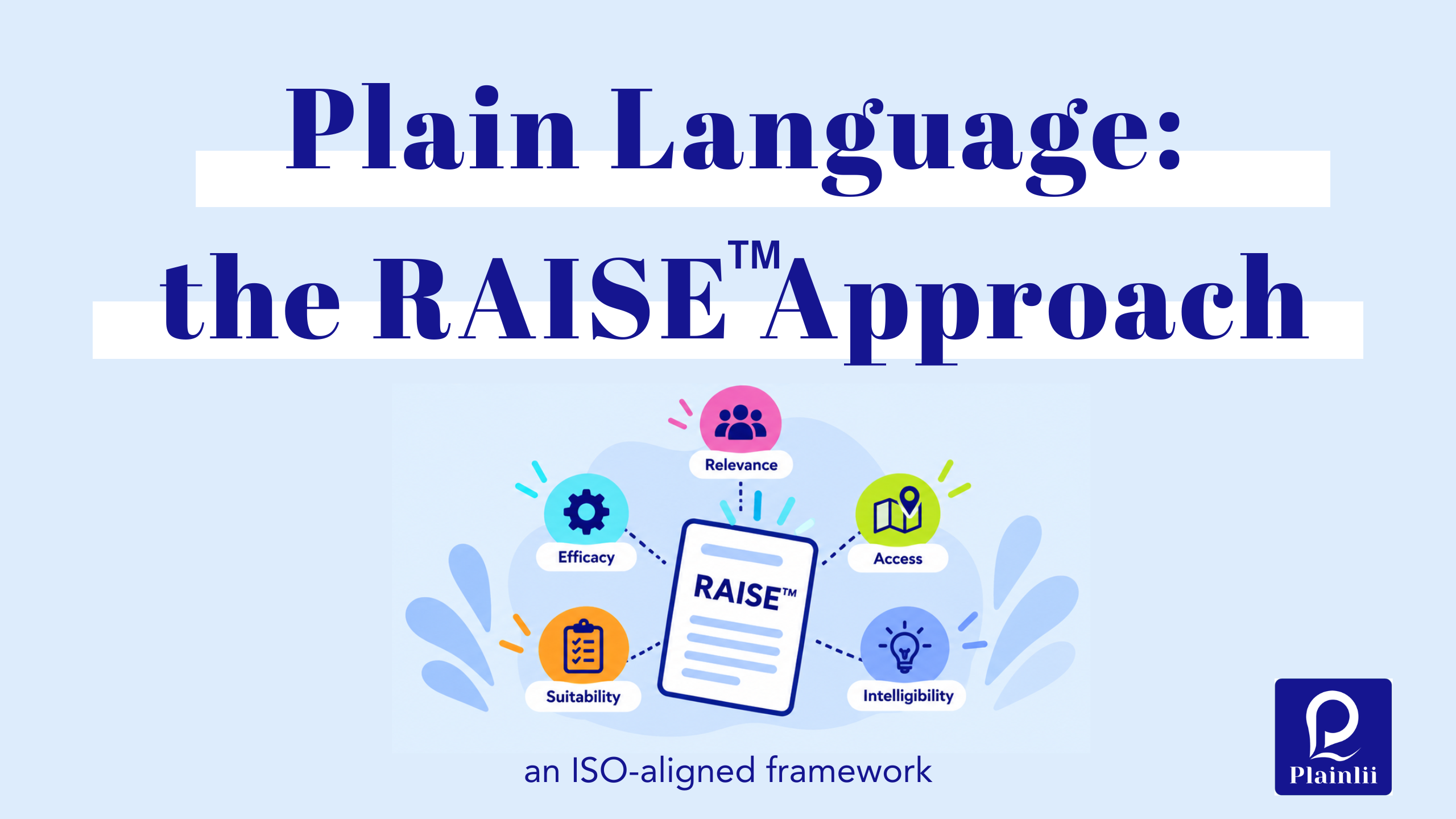
This is the course image on learn.plainlii.com. Look for it on your dashboard after you enroll.
What You’ll Learn
Through short videos, real before-and-after examples, and hands-on practice, you will learn how to:
- put your readers first with personas and need-to-know content
- lead with the main point so busy readers get the message
- organize and design documents so readers can find what they need
- choose familiar words and build clear, connected sentences
- write with empathy, the right tone, and bias-free language
- edit dense or technical text step by step, from obscure to clear
- use AI tools wisely, and check what they produce
- test your writing with real readers and improve it
You'll work on one real document from your own job throughout the course. By the end, you'll have reviewed and revised it with the same tools professional plain language editors use.
Self-paced, about 15 hours. Includes a Plain Language Guide, a one-page checklist, and a review cheat sheet you can keep using at work.
Course Syllabus
Course Syllabus Overview
The course has a welcome section and eight modules. Each module teaches one RAISE™ principle and one or more of the 7 Steps to Clarity, with a short video, lessons, practice activities, and a knowledge check.
You finish with a capstone: a full RAISE™ review and redraft of your own document, reviewed by your peers. Complete the course to earn a badge and a certificate of completion.
Start Here: Welcome and Orientation
Meet the instructors, see how the course works, and choose the document you'll improve.
- Welcome video and course path
- Introduce yourself as a persona
- Choose your practice document
Module 1: What Plain Language Is and Why It Matters
Learn what plain language is — and what it isn't.
- The ISO 24495-1 definition: find, understand, use
- Wording, structure, and design working together
- Lay plain language, technical plain language, and Easy Read
- A short history, from "gobbledygook" to the ISO standard
- Five benefits: time, money, credibility, compliance, peace of mind
- The RAISE™ framework and the 7 Steps to Clarity
Module 2: Relevance — Know Your Reader
Plan content around the people who will use it.
- Reader personas and the reader journey
- Literacy, situations, and barriers to understanding
- Five biases that affect writers and readers
- Schemas: how titles connect to what readers know
- Need-to-know content and bottom line up front (BLUF)
Module 3: Accessibility — Organize and Design
Help readers find what they need, in any format.
- Eight patterns of organization
- Headings, styles, layout, and clear forms
- Tables, charts, infographics, and honest visuals
- Gestalt principles and design rules for everyone
- Digital accessibility and WCAG basics
- Using AI to draft visual aids
Module 4: Intelligibility — Clear Words and Sentences
Make every word and sentence easy to follow.
- Familiar words, explained terms, and fewer acronyms
- Five common mistakes and how to fix them
- Who-does-what sentences, active and passive voice
- Parallel lists and end weight
- Punctuation with a purpose
Module 5: Intelligibility — Logical Flow and Stepwise Editing
Connect ideas so the whole text makes sense.
- Cohesion: linking sentences with words and grammar
- Coherence: topic, information flow, and clear relationships
- The stepwise approach to editing, from technical to lay language
- Using AI to create versions — and checking the meaning
Module 6: Suitability — Empathy, Tone, and Bias-Free Language
Write so readers feel respected and supported.
- Empathy in communication
- Acknowledge, Guide, Enable (A.G.E.)
- Bias-free language
- Making numbers relatable
- A tone that is direct and kind
Module 7: Efficacy — Revise, Test, and Get Feedback
Find out whether your writing works.
- What readability formulas measure — and what they miss
- Checking understanding with PARCA
- Expert reviews and reader testing
- Revising in layers
- AI as a second reader
Module 8: Capstone — A Full RAISE™ Review
Bring it all together on your own document.
- Warm-up case: reviewing a real-world notice for four different readers
- RAISE™ review and redraft of your practice document
- Peer review with the Plain Language Review Cheat Sheet
- Badge and certificate of completion
Contact us
Reach out, we try to answer all emails within 24 hours on business days.
We will be happy to answer your questions and help you achieve bolder communication results with writing, translation, and elearning!