
From Chaos to Clarity: Plain Language for Localizers
Bring order to multilingual, AI-driven content.
Learn what plain language really is, why a plain source makes better translations, how plain content becomes infrastructure for AI systems, and how to prove it works with real readers in every language.
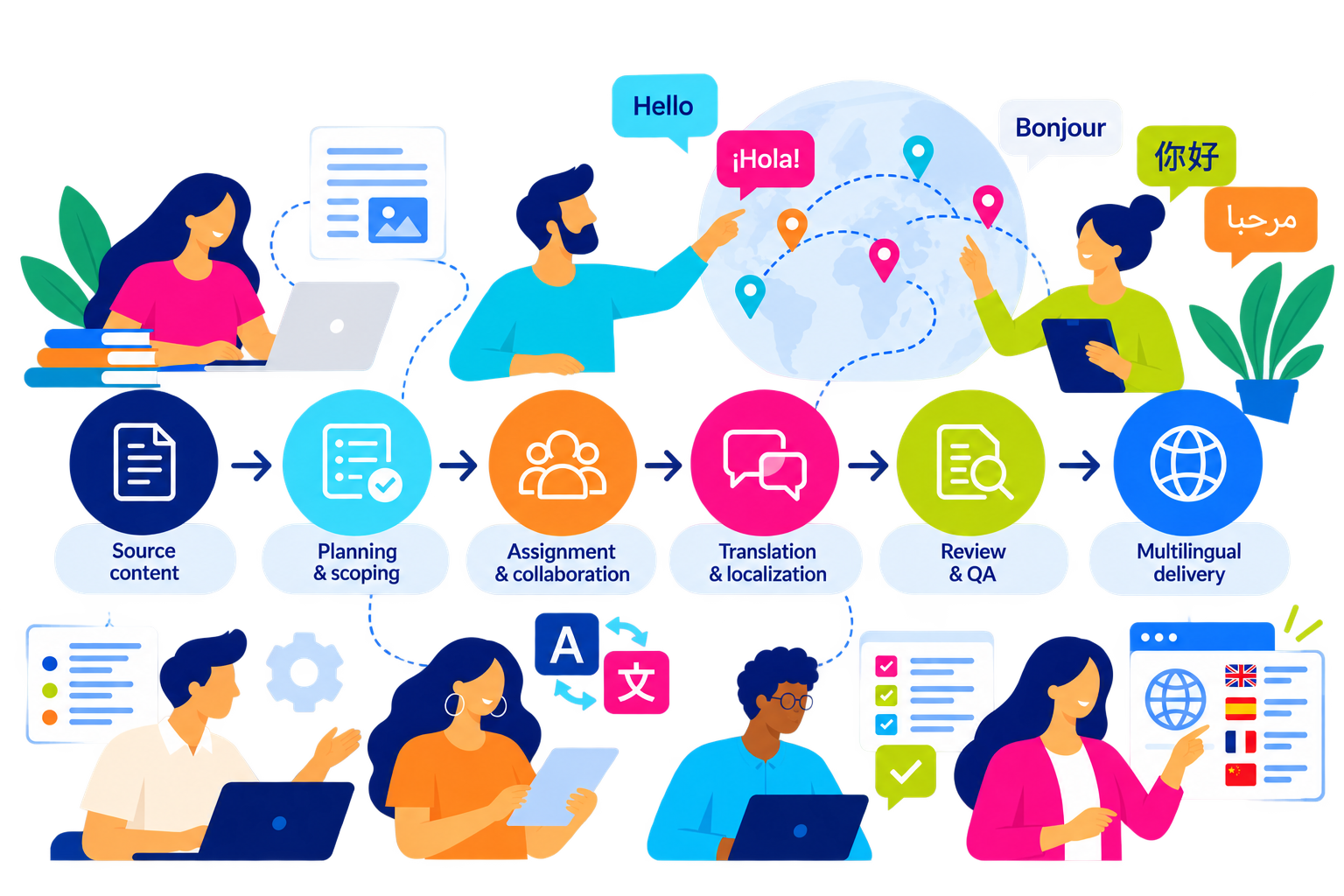
Why This Course Matters
AI is everywhere in our industry, and the landscape feels chaotic. Content now goes to translators, machine translation engines, chatbots, search and generative AI, often all at once. When the source is unclear, every one of them inherits the problem, in every language.
Localizers are well placed to bring order to this. We turn raw technology into content people can trust and use. Plain language is how we do that at the source: a plain source makes translation faster and more accurate, and a plain target completes the effect for readers.
This is the course image on learn.plainlii.com. Look for it on your dashboard after you enroll.
What You’ll Learn
Through short videos, readings, hands-on labs and discussion with other localizers, you will learn to:
- define plain language using ISO 24495-1, and explain why it covers structure and design, not just words
- explain how a plain source improves human and machine translation, and how a plain target completes the effect
- assess source content as input for chatbots, search, RAG and generative AI
- design a small test that shows whether real readers can find, understand and act on content in each language
You’ll finish with a Chaos to Order audit of one real piece of multilingual content, built step by step as you go through the course.
Who This Course Is For
Localization managers, project managers, translators, reviewers, content strategists and anyone who prepares content for other languages or for AI tools. No technical background is needed.
The course has four modules of about 90 minutes each, plus a capstone: about 7 hours in total. Take it with a live cohort or on your own schedule.
Choose How You Want to Learn
Both options cover the same four modules and capstone.
Live Cohort
Learn with a group of localizers and Romina Marazzato Sparano, on set dates.
- live sessions with the instructor
- feedback on your labs and capstone
- discussion with your cohort
Next cohort: dates coming soon. Reserve your seat now.
On-Demand Course
Start today and work through the course on your own schedule.
- instant access to all modules
- videos, readings, labs and knowledge checks
- build your Chaos to Order audit at your own pace
Course Syllabus
Course Syllabus Overview
The course has a welcome section, four modules and a capstone. Each module includes short lessons, a video, a hands-on lab or assignment, a discussion, and a knowledge check or written task.
Your capstone pulls together your work from each module into one Chaos to Order audit: a content audit, a plain language revision, a machine translation comparison and a test plan.
Module 1: What Is Plain Language?
Go beyond words: the international definition, the principles and the standards behind plain language.
- 1.1 Beyond words
- 1.2 The ISO definition
- 1.3 The four principles
- 1.4 The standards landscape
- 1.5 The AI myth
Lab: Score an AI rewrite. Ask an AI tool to rewrite a sample text in plain language, score the result against the four ISO principles, and note what got better and what got worse.
Module 2: Plain Language and Translation
See why a plain source makes better translations, and how to measure the difference.
- 2.1 A shared objective
- 2.2 The compounding effect
- 2.3 Source features that break translation
- 2.4 Case study: European Parliament machine translation tests
- 2.5 Measuring the difference
Lab: Before-and-after MT. Run a short text through machine translation, revise the source with plain language guidelines, run it again, and annotate errors in both outputs with a simplified MQM typology.
Assignment: a short business case for plain source content, written for a localization buyer.
Module 3: Plain Language as Infrastructure for AI and Global Content
One source now feeds many consumers. Learn what machines need from text and how plain content keeps them accurate.
- 3.1 One source, many consumers
- 3.2 What machines need from text
- 3.3 Retrieval and grounding
- 3.4 Terminology and structure as order
- 3.5 Human intelligence in the loop
Lab: Ask the chatbot. Ask a chatbot five questions about a dense page, then about a plain rewrite of the same page. Compare the answers and score the page on a machine-readiness checklist.
Module 4: How Do We Know Plain Language Works?
Guidelines are not evidence. Learn to test content with real readers, in every language.
- 4.1 Guidelines are not evidence
- 4.2 What to measure
- 4.3 How to test
- 4.4 Testing across languages
- 4.5 From evidence to practice
Assignment: Evaluation plan. A one-page plan for a real piece of content: goal, audience in each locale, method, measures and success criteria. Then review another learner's plan.
Capstone: Chaos to Order Audit
Put it all together: your audit, revision, machine translation comparison and test plan for one real piece of multilingual content. Finish by sharing the first step you will take in the next 30 days to bring order to your source content.
Contact us
Reach out, we try to answer all emails within 24 hours on business days.
We will be happy to answer your questions and help you achieve bolder communication results with writing, translation, and elearning!