Plain Language Has No Political Color — And Europe Is Proving It
Today marks an exciting moment in the trajectory of plain language: the European Parliament has officially renamed its translation service the Directorate-General for Translation and Clear Language.
Beyond the institutional news, this change reflects something Plainlii has championed from the start: plain language is not a political stance — it’s a democratic essential.
A Growing Movement Toward Clarity
Across governments and organizations, plain language is no longer seen as an optional communication style or a kindness reserved for newcomers or vulnerable groups. It is becoming a pillar of democratic participation, an essential part of public trust, and a practical tool for good governance and effective business.
The European Parliament’s decision to explicitly include Clear Language in its official name marks a milestone in this trajectory — a sign that clarity, accessibility, and transparency are not afterthoughts but core responsibilities.
Plain Language Has No Political Color
Plain Language has no political color. It’s a tool that serves everyone — regardless of party affiliation or ideology.
When government agencies, organizations, and businesses communicate clearly, they build trust across the political spectrum. Plain language removes barriers that prevent people from understanding their rights, fulfilling obligations, and taking part in civic life.
In the private sector, clear communication:
- builds customer loyalty
- prevents disputes
- reduces operational complexity
- and saves time and money
Clarity benefits:
- Conservatives who want efficient, accountable institutions
- Progressives advocating for accessible services
- Independents seeking transparency in decision-making
- All people who deserve to understand information that affects their lives
Plain language works because it belongs to no one — and everyone.
Why the European Parliament’s Move Matters
The Parliament’s new name signals that plain language is becoming embedded in the very structure of European democracy.
It acknowledges that:
- translation and comprehension must go hand in hand
- multilingual democracy depends on accessibility
- citizens deserve information they can understand immediately
- clarity is essential for trust, equity, and democratic legitimacy
This isn’t branding. It’s an institutional shift — and a powerful example for governments worldwide.
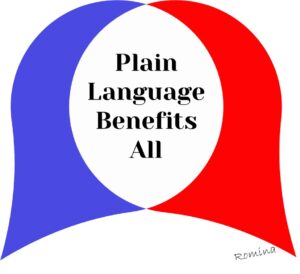
Pomp and Gobbledygook Close Doors. Plain Language Opens Them.
Pompous and dense writing exclude rather than informs, and at best gives “the illusion of having learned” (see a Dr. Fox Experiment, paper and video) . Bad writing allows bad actors to hide harmful terms and gives pedants a
space to mask their ignorance. This happens both in public-facing communication and in technical documents in which writing becomes unnecessarily complicated.
Technical complexity is not the enemy. Unnecessary opacity is.
Subject-matter experts need precision, and focused fields genuinely require specialized terminology. But too often, technical communication becomes dense by habit, not necessity — written to impress peers rather than communicate. Internally, this breeds confusion, slows decision-making, and creates silos where only a few people truly understand what’s going on.
Meanwhile, outside of expert circles, people sometimes use jargon-laden lay language — not because it’s clearer, but because it sounds authoritative. The effect is the same: it shuts people out.
Plain language does the opposite:
- it fosters trust
- it promotes accountability
- it strengthens civic participation
- it empowers both majority and minority voices
- it supports informed decision-making inside organizations and industries
- it helps experts communicate accurately and accessibly without sacrificing precision
Good governance and good business both require informed participants — whether those participants are citizens, customers, colleagues, or technical stakeholders.
Plain language is how we get there — together.
Clarity Is the Future
At Plainlii, we see the European Parliament’s decision as a sign of what’s ahead: a world where clarity is expected, not exceptional — where people are treated with respect through communication they can understand.
Whether someone is a newcomer or a lifelong resident, multilingual or monolingual, highly educated or learning as they go — everyone deserves clarity.
Plain language isn’t political. It isn’t ideological. It’s fundamental.
Good communication doesn’t divide; it connects.
Plain language is about thinking clearly and expressing ideas in a fitting style for the audience. Above all, it’s a commitment to respect and shared understanding in business and civic life.