Plain Language Framework: Why RAISE™ Five Principles Go Beyond ISO 24495-1
Different frameworks inevitably reflect the emphasis placed on different aspects of communication. ISO 24495-1:2023 organizes its guidance around four governing principles—relevant, findable, understandable, and usable—with “understandable” encompassing a wide range of linguistic and structural considerations, from wording to tone to cohesion. This structure serves the purpose of the standard, which is to provide a broad, outcome-based framework for authors across contexts. My plain language framework differs from ISO 24495-1:2023 because it expands the four principles into five, grouped in my trademarked RAISE™ framework, which includes Relevance, Access, Intelligibility, Suitability, and Efficacy.
Unpacking “Understandable” in a Plain Language Framework
In my own practice, I have found it helpful to unpack “understandable” into the two distinct dimensions of Intelligibility and Suitability. I separate these not to diverge from the standard but to make explicit two linguistic aspects that require different kinds of decisions from authors—and which, while not discrete or sequential, can build on each other. So, RAISE™ offers a practical way to operationalize two linguistic dimensions at the heart of clear communication: how meaning is structured and how expression fits the audience, making them more visible and actionable for writers.
Intelligibility refers to what linguists call textuality: the construction of meaning through grammaticality, cohesion, and coherence. While ISO includes cohesion as a guideline under the Understandable principle (5.3.8), coherence—how ideas hang together logically and conceptually—deserves equal visibility, if not more! Cohesion and coherence interact to create clarity of thought, and the challenges involved in maintaining them differ markedly from those involved in shaping tone or choosing vocabulary. Treating intelligibility as its own principle highlights the cognitive work of structuring ideas so readers can follow the logic without undue inference.
Suitability, by contrast, involves adequacy: aligning tone, register, and stylistic choices with the needs, expectations, and cultural context of the intended audience, and the media and channels of communication. ISO situates tone within Understandable (5.3.7) as part of projecting respect and inclusiveness, but, in practice, style involves a broader set of interpersonal and contextual decisions. These choices carry substantial weight in whether readers feel seen, respected, and invited into the text as valid interlocutors.
Separating intelligibility and suitability is thus a practical decision rooted in how writers think and work. Authors routinely struggle with structure and idea-flow on the one hand, and with tone, voice, and audience fit on the other. When these are treated as one principle, the risk is that one dimension, often coherence, receives less attention than it needs for the text to succeed—especially in longer texts required for explanations and learning.
How Quadrants Support a Plain Language Framework
In the Visual Plain Language Guide (find the Guide here), I map written communication onto four quadrants defined by two intersecting dimensions: clarity of thought (cohesion + coherence) and adequacy of expression (tone, register, vocabulary). These dimensions generate four distinct types of text: clear technical communication, clear lay communication, poor technical writing, and poor non-technical or lay writing—what we often call gobbledygook.
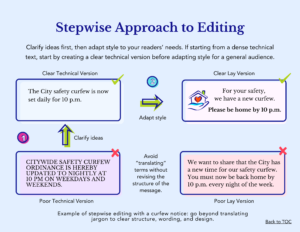
This quadrant view makes one point especially visible: clear thinking is transferable. When the underlying ideas are coherent and well-sequenced, it becomes possible to create both a clear technical version and a clear lay version from the same conceptual core. Structure and logic remain stable; only the expression layer changes, as it were.
By contrast, when a document lands in the “poor” half of the chart—whether technical or lay—it usually signals problems in the idea layer, not just the wording. No amount of de-jargoning will fix incoherent content because the problem isn’t in the lexicon; it’s the absence of a rationale.
This quadrant model therefore underscores why I separate intelligibility from suitability in my five-principle framework. Cohesion and coherence give you the internal architecture that supports multiple versions for multiple audiences. Tone and register then allow you to adapt that architecture for readers with different backgrounds, needs, or levels of expertise. Clear thinking first; clear expression follows.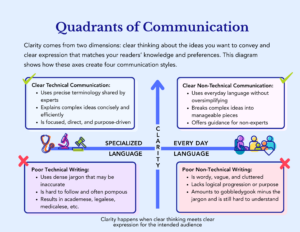
Why Clear Thinking Matters in a Plain Language Framework
In this framework, clarity of thought is essential for reader understanding and it also becomes a powerful tool when creating different versions of the same content for multiple audiences. When the underlying ideas are coherent (logically sequenced and structurally sound), it becomes much easier to adapt the message for audiences with different levels of expertise, cultural backgrounds, or communication needs. A well-formed conceptual architecture allows you to adjust vocabulary, tone, and examples without having to rebuild the message each time. In other words, textuality provides the stable “skeleton” of meaning, and adequacy lets you tailor the “surface” for each group. This separation of layers is particularly useful in multilingual contexts, regulated environments, and collaborative projects where stakeholders require variations of the same content. Starting with a clear, coherent core reduces duplication of effort and results in versions that remain aligned in purpose and substance while meeting readers where they are.
A Clearer Tool for Writers
Ultimately, I use five principles not to complicate the ISO model but to give authors a clearer diagnostic tool. Distinguishing clarity of thought (intelligibility) from kindness of expression (suitability) helps writers recognize which choices affect the logic of the message and which affect its relationship with readers. Both contribute to understanding, but they do so through different mechanisms. Making that distinction explicit supports better planning, drafting, and revising—while remaining fully compatible with the intent and scope of ISO 24495.
Note: Access in the RAISE™ Framework includes organization of the message, structure of the document, multimedia supports, and digital accessibility as defined by WCAG Standards.